Drag the floor or use ← → to visit other rooms
Every student gets the whole year’s list on the first day, then a random sample of it every week. Nothing can be crammed, so nothing is forgotten.
The table of contents is the curriculum; the rest of the book is just one method of teaching.
Clarity, then a random sample
Hand out the whole year in week one
A numbered list of the key concepts to be learned in the whole course, which is most often a year: clear, specific and measurable, in language students understand. Only the essentials; leave the trivia out. The list is the destination for the year’s learning journey.
Leave nothing behind from earlier grades
Each concept has one grade where it is learned, with no duplicates, but earlier learning stays on the quizzes. A fourth-grade math quiz might hold seven fourth-grade questions, two from third grade and one from second. One middle and high school science department gives half of every quiz to earlier science courses.
Quiz a random sample, nearly every week
- 25–50 concepts
- 8 questions
- 51–100 concepts
- 10 questions
- 101–150 concepts
- 12 questions
- 151–250 concepts
- 16 questions
- Above 250 concepts
- 20 questions
About the square root of the list; the table gives the range. The quiz is not graded, and its questions both preview what is still to come and review what students are remembering. The items go back in the bowl, so any concept can come up on any quiz.
Use a rubric for skills
When the goal is a skill rather than content, a Dichotomous Rubric takes the place of the concept list. Each line is simply yes or not yet.
Try it: a year of U.S. Constitution, in 64 concepts.
A real course list, by teacher Dan McCaulley. Students get all 64 on the first day.
- The year’s list
- This week’s quiz
- Week after week
This is the whole year. Tap any number to see what it asks, then draw the first week’s quiz.
This week’s quiz
Draw a week to see its eight questions here.
Dan McCaulley is the author of Continuous Improvement in the Social Studies Classroom; his quiz is free in Free Resources.
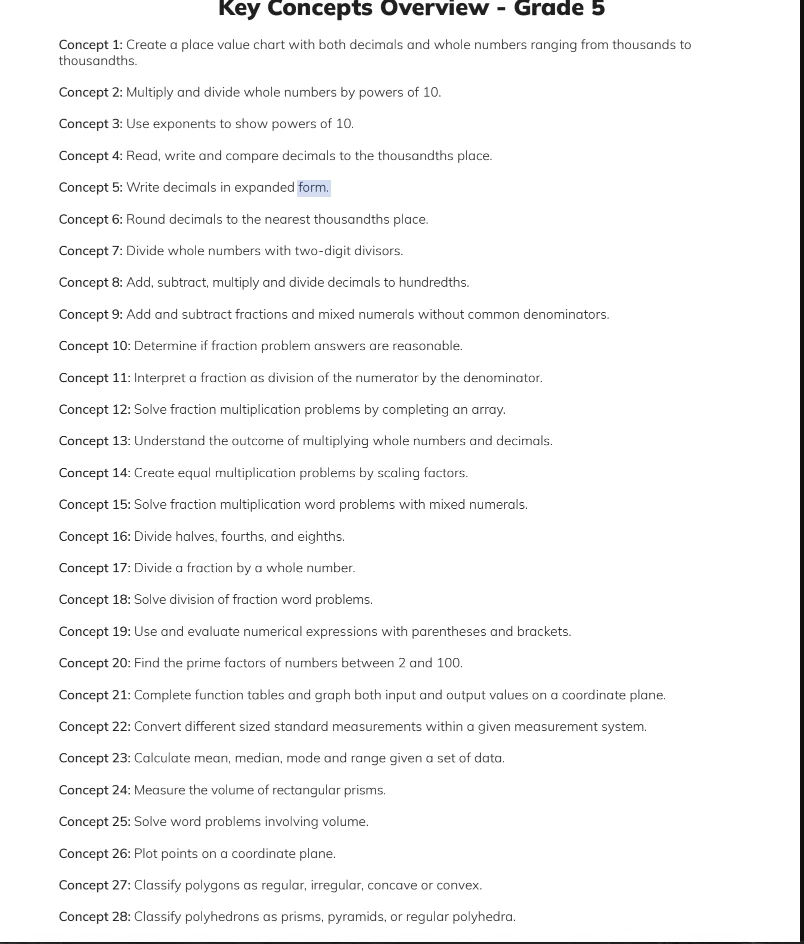
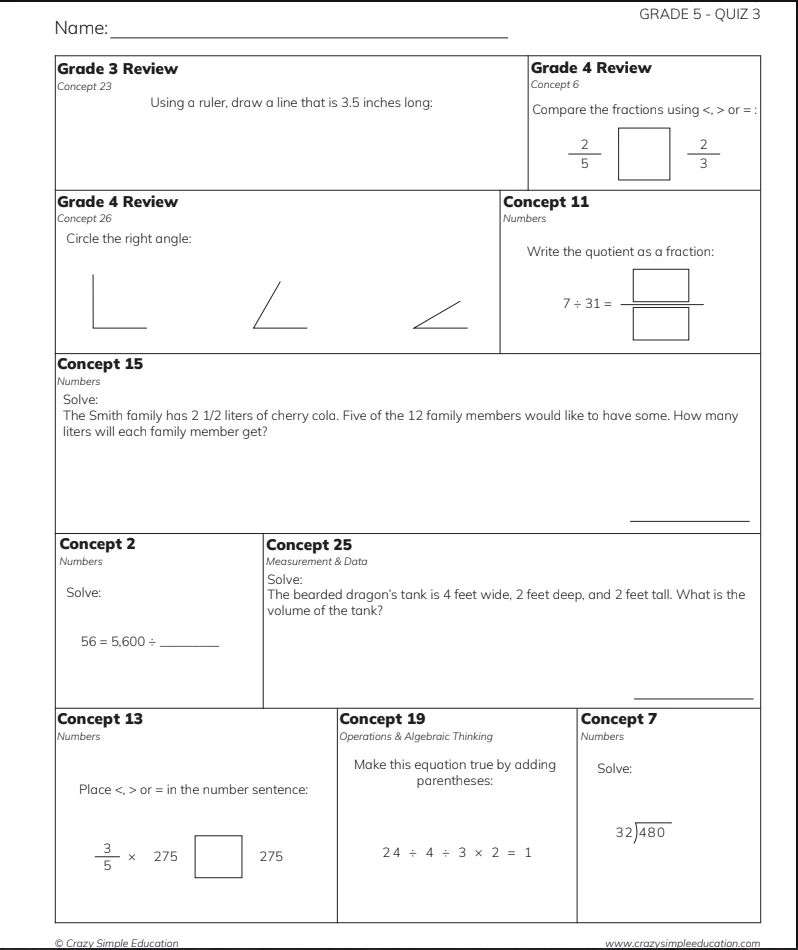
One year of grade 5 math, and a quiz drawn from it
The list students receive in week one, and one of the quizzes that follows. Each quiz question is labelled with its concept number, so students can find it on the list.
From the keynote
Dr. Jenkins, speaking to educators, on why the whole year goes out in week one.
A biology course’s key concepts, root words and suffixes, on a single sheet: why students get the whole year in week one.
Let AI draft; teachers decide
Artificial intelligence can draft key concepts for each subject and grade level. Teachers refine the drafts and set the final expectations, and a shared database lets staff and parents see them, and teachers spot connections across courses.
This is not a syllabus. The syllabus is what’s to be taught. Key concepts define what’s to be learned.
 Dr. Lee Jenkins“It’s Eerie — But We Can Predict the Future of Education”, Education Today, 2025
One orchestra, eleven scales
Susan Barnes knew her students needed to play six major and five minor scales without thinking. She “preached” it to them for years; it didn’t work. So the eleven scales became her key concepts, and a dichotomous rubric scored each one.
Week one: A baseline
Each day one of the eleven scales is drawn at random, and four students, also at random, play it for two octaves. Almost every score on the 1–4 rubric is a 1. The week’s total is the score to beat.
First semester: One scale at a time
She teaches the scales one by one, in a logical order, and every day four students are drawn to play: anyone can be chosen twice in a week, or not at all. On Friday the class adds up its scores. Is it an All-Time Best?
Second semester: Any scale, any day
Now any of the eleven can come up. Four students play it each day, and the class helps score every player, counting accurate notes and beats per minute.
120beats per minute
Her students now play their scales accurately at a minimum of 120 beats per minute, and the growth is on the class run chart for all of them to see.
- New songs are learned much faster. Every student knows the scales, so no one is tripped up by the sharps and flats of a key, and sight reading moves quicker.
- The process leads straight into the Circle of Fifths: the theory her students need to start college music with success.
- It unified her curriculum. Each year she and her students agree how to improve it; three years in, she is very pleased.
I am a better teacher because my focus on scales does not wane as the year progresses. The students keep me on my toes. “Mrs. Barnes, aren’t we going to do LtoJ® [prior name for Learning That Lasts] today?”
 Susan BarnesOrchestra and vocal music, Wilmer Amina Carter High School, Rialto, California
Teachers on the key concept list
“When the year comes to a close and the students realize that they have learned what the teacher said they would learn, it is so very powerful!”
 Julie OteroNebraska Department of Education; formerly Superintendent, Centura School District, Cairo, Nebraska
“Since incorporating this activity into my class, my final exam scores have increased and I feel that all students leave my classroom with a greater understanding, than ever before, of how the Government works.”
 Kelsey LovsethGrade 12 government teacher, Brookings High School, Brookings, South Dakota
“We are both amazed at how many questions students are answering correctly on the comprehensive exam for content that has not yet been taught.”
 Laura HayesPrincipal, Massac Junior High School, Metropolis, Illinois
“Coming out of college as a first-year teacher you have no idea where to start. Lee Jenkins provides the road map all teachers, K-12, need to organize, teach and be successful.”
 Codi HroudaGrade 5 teacher, South Sioux City, Nebraska
Key concepts and rubrics in classrooms

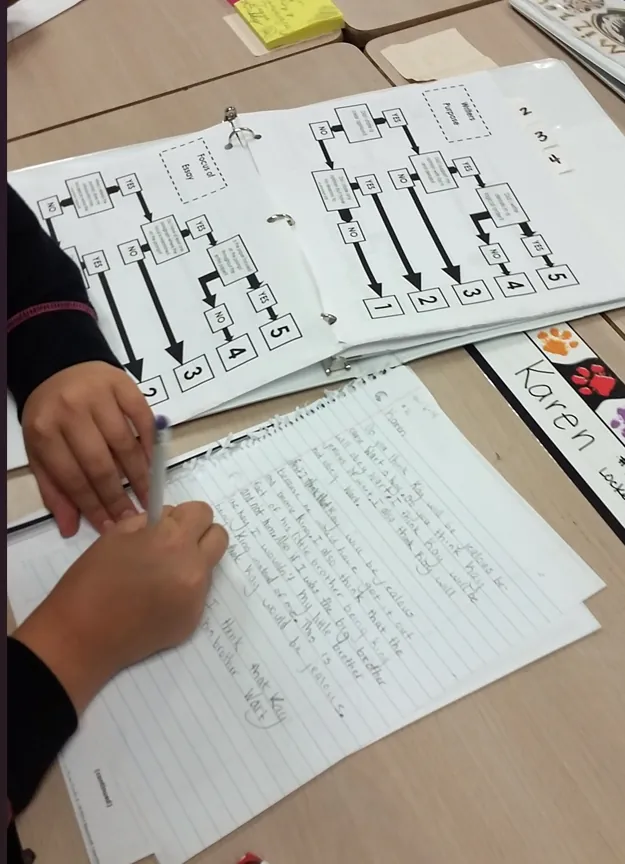
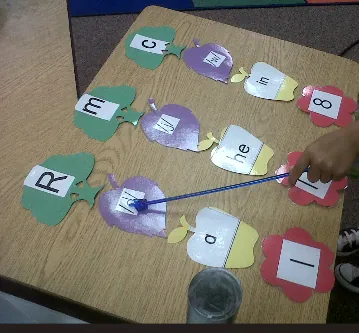
Give every classroom in your district a clear destination.
Lee’s process works with any grade level and any subject. Works even better if aligned across grade levels.